

无论你在哪里,你都在教堂里




.webp)
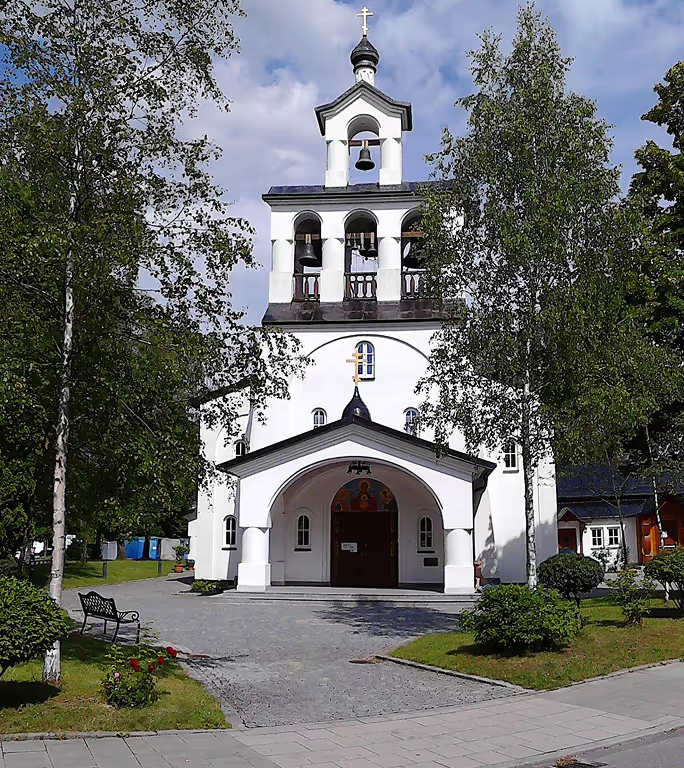
Church of St. Spas - Church of the Ascension of the Lord
Divine services at St. Spas are held every day:
Morning Matins begin at 8:00 AM, and the Evening Service begins at 6:00 PM. On days when the Divine Liturgy is celebrated, Matins is not served.
The Divine Liturgy is celebrated every Sunday and on all major feast days (red-letter days in the church calendar) at the Church of St. Spas, except on the third Sunday of each month and on feasts dedicated to the Mother of God, when the Divine Liturgy is held at the Cathedral Church of the Dormition of the Most Holy Theotokos instead.
关于
Situated on a gentle hill above the city of Šibenik, next to the Orthodox cemetery, stands the Church of the Ascension of the Lord, popularly known as St. Spas (Holy Savior).
As the Serbian community rapidly grew during the 18th century—especially with the presence of prosperous merchants—the need arose for a larger place of worship. For this reason, in 1778 the local Serbian Orthodox faithful built this church to serve their spiritual needs.
Although the Church of the Dormition of the Most Holy Theotokos serves as the cathedral church of the Dalmatian Diocese, the Church of St. Spas was designated as the place where daily services would be held.
日程安排
上午 9:30 集合
周日上午 9:30
上午 9:30 集合
周日上午 9:30
上午 9:30 集合
周日上午 9:30
联系人
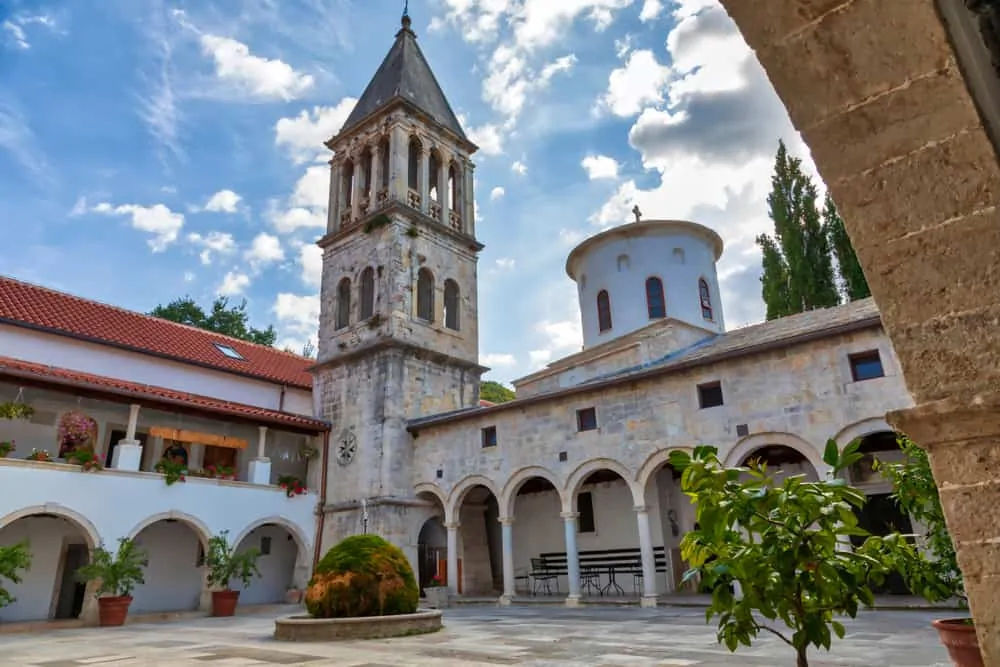
Krka Monastery
Today, services are held at the monastery daily. Matins is served at 7:00 a.m., and Vespers at 6:00 p.m. On Sundays and feast days, Matins begins at 8:00 a.m., followed immediately by the Divine Liturgy.
Krka Monastery remains a living spiritual center, a place of pilgrimage, prayer, and encounter with the rich spiritual and historical heritage of the Orthodox Church.
关于
Krka Monastery is located three and a half kilometers east of Kistanje, in the picturesque canyon of the Krka River, from which it takes its name. This ancient holy site is one of the most important spiritual centers of the Serbian Orthodox Church in Dalmatia and has borne witness for centuries to the Orthodox Christian presence in this region.
According to tradition, the monastery was founded in 1350 by the Serbian princess Jelena, sister of Emperor Dušan, who was married to the Croatian nobleman Mladen III Šubić. She dedicated the monastery to the Holy Archangel Michael. Tradition also says that monks who came from the Holy Land, from the Monastery of the Holy Archangel Michael near Jerusalem, took part in establishing this holy place, encouraged by the spiritual father of Princess Jelena, the monk Rufim.
Throughout its long history, Krka Monastery has been a spiritual, educational, and cultural center of the Serbian people in Dalmatia. A theological school once operated within the monastery, liturgical books were copied and preserved there, and many monks, priests, and bishops came from this holy community. Over the centuries, the monastery shared the fate of the people, enduring periods of suffering and renewal, yet it has remained a place of prayer, gathering, and spiritual strength.
日程安排
上午 9:30 集合
周日上午 9:30
上午 9:30 集合
周日上午 9:30
上午 9:30 集合
周日上午 9:30
联系人
Greek Orthodox Church of the Saviour
关于
As Munich expanded in the late 15th century, inner-city cemeteries were relocated. St Salvator was built to serve the Frauenkirche cemetery: shell likely completed April 1493, consecrated 15 Aug 1494 (master builder probably Lukas Rottaler). A gallery was added in the 17th c.; after lightning damage in 1767 the Gothic spire was replaced by a Baroque onion dome; 1774 saw renovation. Secularization brought clearance/demolition decrees in 1803/04, never executed due to lack of depot space. 1806 King Max I Joseph gifted the church to the Lutheran community, yet it remained a storage site. Through Friedrich Thiersch’s advocacy, King Ludwig I granted it to the Greek community in 1828; Leo von Klenze adapted it for Orthodox worship, consecrated 18 Dec 1829. The tower was regothicized in 1869; stained glass was variously removed/reinstalled (1903/1928/1941). The structure largely survived WWII, though much glass was lost. Key works followed: 1970 iconostasis moved back, 1982 roofing, 1992/93 exterior repairs, 2000 four restored windows reinstalled, 2008 tower renovation, 2009 new portal.
日程安排
上午 9:30 集合
周日上午 9:30
上午 9:30 集合
周日上午 9:30
上午 9:30 集合
周日上午 9:30
联系人
Serbian Orthodox Church of Saint Martyr Jovan Vladimir
Divine Liturgy: Every Sunday at 09:00
Daily services (on regular days):
Morning service (Matins): daily at 09:00
Evening service (Vespers): daily at 18:00
Friday devotional service:
Every Friday at 18:00 – Akathist to the wonderworking icon of the Most Holy Theotokos of Lepavina
关于
The roots of the Serbian Orthodox community in Munich go back to the difficult years surrounding the Second World War. In the 1940s, Serbian believers in Germany first gathered for worship in camps and temporary chapels. In 1946, a Serbian Orthodox Community for Germany was formally organized and recognized by Bavarian authorities, marking the beginning of an official church presence in the region. Just one year later, in 1947, the Serbian Orthodox Church Municipality of Munich was founded, initially using borrowed spaces in various parts of the city.
Over the following decades the community moved several times as it grew, celebrating services in chapels and halls at different addresses across Munich. In the 1980s the parish began planning a permanent church and cultural center that would reflect both Serbian Orthodox tradition and its new Bavarian home. Construction of the church dedicated to Saint Jovan Vladimir started in 1995 on Putzbrunner Straße, and the building was first consecrated in 1996. In the years that followed, a chapel was added and the interior iconography was completed, so that today the church stands as a fully developed Orthodox sacred space and a lively hub for worship, catechesis, language school and cultural events.
Note: Times are given in local Munich time (CET/CEST). Feast-day schedules and special services can vary; checking the parish calendar or contacting the office before a visit is recommended.
日程安排
上午 9:30 集合
周日上午 9:30
上午 9:30 集合
周日上午 9:30
上午 9:30 集合
周日上午 9:30
联系人
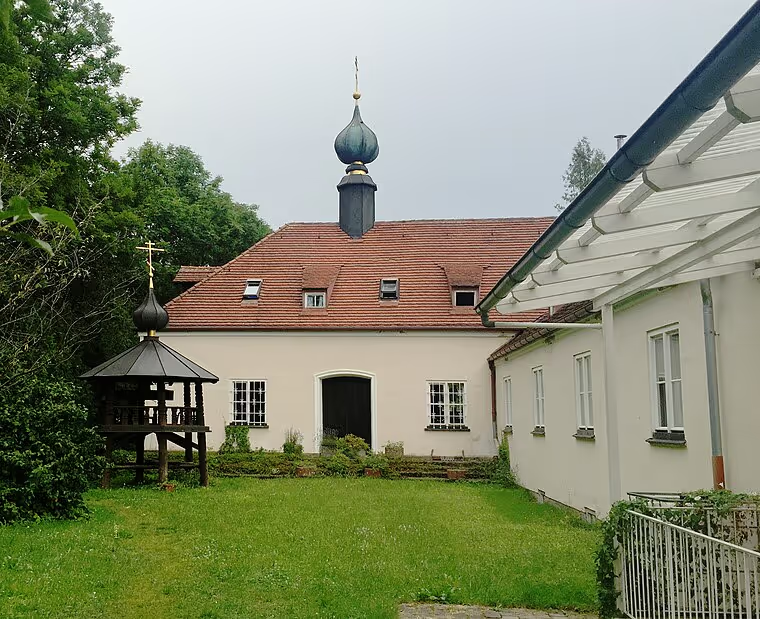
Russian Orthodox Monastery of St. Elizabeth
关于
Location & Founding.
In picturesque Buchendorf near Starnberg (≈700 residents), about 17 km from downtown Munich, an Orthodox women’s monastery dedicated to St Grand Duchess Elizabeth has existed since 2005, directly behind the Roman Catholic Church of St Archangel Michael.
Prayer & Worship.
At the heart of monastic life are divine worship and personal prayer. The full daily liturgical cycle is served each day; the Divine Liturgy is celebrated three to four times a week, including Sundays.
Work & Crafts.
The monastery maintains a prosphora bakery, sewing room, embroidery, and bookbindery. The sisters cultivate a vegetable garden (raising seedlings in greenhouses), plant potatoes, keep chickens, and run beekeeping. Honey and propolis supply the monastery’s small natural apothecary, where handmade salves of various compositions are prepared.
Youth & Formation.
Since its founding, the monastery hosts the annual Martha-Mary Summer Camp for girls, offering an introduction to monastic life and friendships with peers from Orthodox parishes across Germany and other countries—strengthening their church life.
Spiritual Character.
Following the Gospel model of Martha and Mary, work and prayer are inseparable. Under the guidance of their spiritual father, the sisters unite obedience and prayer in every task. Regardless of duties, all attend the full cycle of services—an expectation also for pilgrims who come for several days to be spiritually renewed.
“The obedience I fulfill in the monastery is entrusted to me by God; my relationship with God depends on how I fulfill it.” — Gerontas Emilianos Vafidis
Leadership.
The monastery is headed by Abbess Maria (Sidiropoulou).
日程安排
上午 9:30 集合
周日上午 9:30
上午 9:30 集合
周日上午 9:30
上午 9:30 集合
周日上午 9:30
联系人
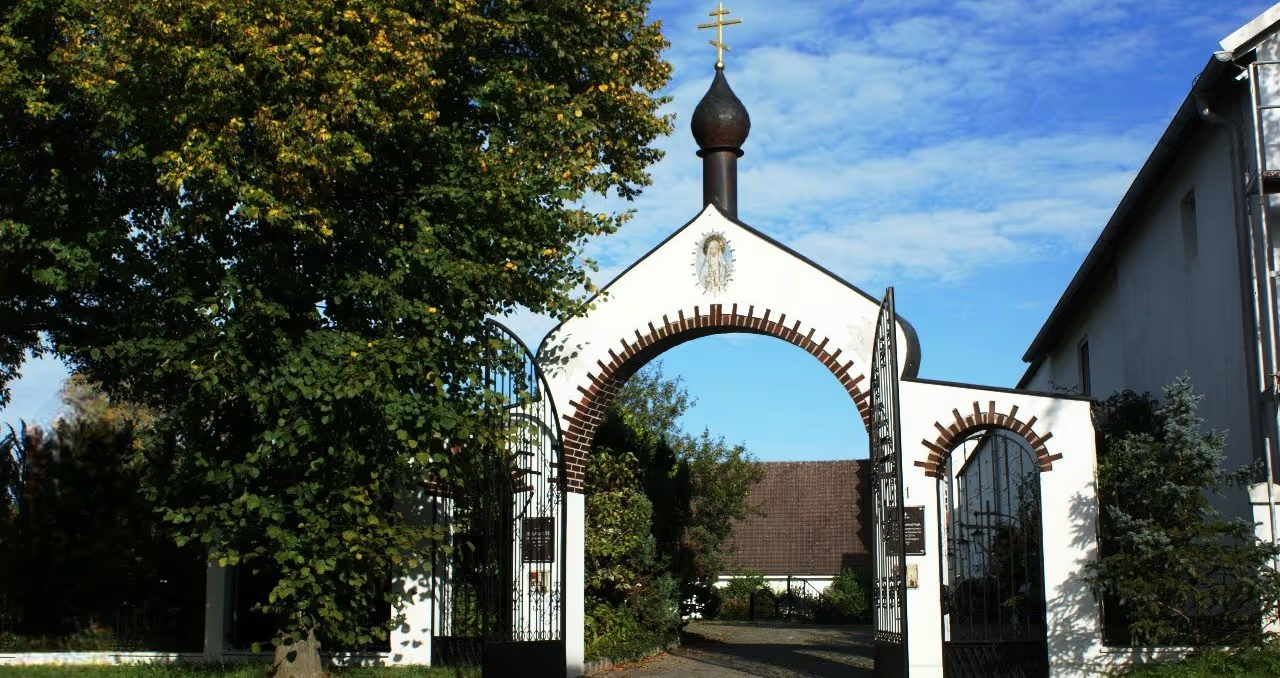
Monastery of Saint Job of Pochayev
关于
From Ladomirová to Munich.
The present Munich monastery traces back to the Monastery of St. Job of Pochaev founded in Ladomirová (Eastern Slovakia) in 1923 by Archimandrite Vitaly (Maksimenko). The brotherhood operated a major printing press and publishing house, shaping the literature of the Russian Orthodox Church Outside Russia (e.g., Pravoslavnaja Rus’, Pravoslavnyj Put’, Pravoslavnyj Kalendar’). In 1944/45, before the advance of the Red Army, the community was evacuated; the group grew to 49 monks, some passing through Geneva into Germany. The Ladomirová monastery was closed in 1946.
A new start in Obermenzing (1946).
At the initiative of Archimandrite Job (Leontyev) and with the help of the US military government, the brotherhood found premises in Munich-Obermenzing. Within a short time they built cells, a refectory, and the Church of St. Job, consecrated on August 28/September 10, 1946. The iconostasis was painted in old-Russian style by Hieromonk Kiprian; frescoes adorn the walls. The small church remains an art-historical gem. By late 1947 the community numbered 32 brethren (some lay). Political insecurity and economic hardship soon led to the emigration of many monks—notably to Holy Trinity Monastery, Jordanville (USA), as well as to Palestine, France, England, Canada, and South America, where new monasteries were founded.
1950s–1970s.
Despite poverty, the monks offered social aid (free meals, clothing) and revived printing: until 1977 some 200 titles (Russian/Church Slavonic) were produced. The monastery ran priest-training courses (e.g., under Archpriest Vasilij Vinogradov) and multi-day meetings for Orthodox Germans, later seminars in Frankfurt and Munich. From 1966–1980 Bishop (later Archbishop) Nathanael headed the monastery; until 1981 it was stauropegial (directly under the ROCOR First Hierarch), thereafter under the German Diocese.
Renewal according to Athonite rule (from 1980).
With Bishop (now Archbishop) Mark, the community undertook a thorough renovation and adopted Athonite rule: a new entrance with tower and crosses, a larger onion dome, and modernization of the press. A basement candle-works has since supplied diocesan needs and supports the monastery financially. Guest rooms were added, annual youth seminars (1982–1994) held, and an individualized priest-formation established, through which over a dozen clergy were ordained in the 1980s. The monastery became a bridge between the émigré community and faithful from Russia, Belarus, and Ukraine.
Today.
The brotherhood continues with publishing, candle-making, incense production, silversmithing, beekeeping, as well as religious education and adult catechesis. Through its printing and educational work, the monastery has become a spiritual center for Orthodox Christians and seekers in Germany and for the Russian diaspora of Western Europe.
日程安排
上午 9:30 集合
周日上午 9:30
上午 9:30 集合
周日上午 9:30
上午 9:30 集合
周日上午 9:30
联系人
Cathedral of the Holy New Martyrs and Confessors of Russia and St. Nicholas
Saturday parish school: 2:00 PM
Church services: Every Saturday at 5:00 PM (Vigil) and Sunday at 9:40 AM (Liturgy)
关于
The Russian Orthodox community in Munich looks back on a long tradition. This applies not only to the 1,000-year tradition since the baptism of Russia, which the community celebrated in 1988 with lectures and an exhibition, but also to the Munich tradition.
When the Russian legation was opened in Munich's Ottostraße in 1798, church services were also to be held here in the chapel, in accordance with custom. Although no further details are known, it is historically certain that from 1832 onwards, the legation staff and their relatives attended the Salvator Church, which was served by Greek clergy. This also applies to the diplomat and poet F. I. Tyutchev (1803-1873), who married in the Salvator Church and had all five of his children baptised there. From 1867 to 1881, there was also the house church of Count Adlerberg, which was moved to Tegernsee when the family relocated there. This house church was dedicated to St. Nicholas, the miracle worker of Myra in Lycia (Asia Minor). Its iconostasis[1] was a gift from Tsar Alexander II, a friend of the Adlerberg family. He had taken it and the liturgical objects given to the Adlerbergs from his dacha in Finland.
"A place of hope and community."
Over the decades, the church has undergone several renovations to accommodate its growing membership and to enhance its facilities for community outreach programs.
日程安排
上午 9:30 集合
周日上午 9:30
上午 9:30 集合
周日上午 9:30
上午 9:30 集合
周日上午 9:30