Is God actually real?
Why does God exist? Explore philosophical, scientific, and theological arguments that point toward the undeniable existence of a higher power.

Where is the evidence?
Learn how faith and logic intertwine, offering compelling reasons to believe in God.
Science
Discover how scientific discoveries about the universe, nature, and life itself suggest there's more behind it all – pointing clearly toward a Creator.
Theology
Understand why faith makes sense. Explore simple explanations from Orthodox Christianity about who God is and why believing in Him matters.
History
See real evidence from history – ancient texts, archaeological finds, and the stories of real people – that show God has been present and active through time.
The Fine-Tuning of the Universe
The laws of physics and the constants of nature are set with astonishing precision, making life in our universe possible. From the balance of cosmic forces to the order found in every living cell, creation reflects a wisdom and purpose that points beyond chance—inviting us to recognize the hand of a Creator.
"The universe seems to have been designed by a pure mathematician."

The Origin of Life
The incredible complexity of DNA and the beginning of life are hard to explain by random chance alone. The detailed information found in every cell points to intentional design and suggests the work of a purposeful Creator.
"The information in DNA is a powerful indicator of a purposeful Creator."
.avif)
The Cell: Molecular Masterpieces
On a microscopic scale, protein complexes operate as engines, conveyor belts, and assembly lines inside every living cell. Each part is essential, and our bodies contain billions of these remarkable cells. Despite such precision and teamwork, they cannot be explained by chance. They rather point to an intelligent Creator who created life in a purposeful manner.
"The cell is like a miniature factory… no machine built by man can match its complexity."
.avif)
The Theological Case for God
Theology is a discipline that studies the nature of God, His revelation, the doctrine of the world and of humanity,
as well as the relationship between God and humankind, systematizing doctrine and religious experience.Here are some theological arguments for God’s existence:
The Moral Argument
Our innate sense of right and wrong points to a moral Lawgiver. Deep inside, we know some things are truly good or evil, not just opinions or customs. This law within us reflects God’s own voice, inviting us to seek truth and live in love.

The Creation Argument
The breathtaking harmony of the universe, from galaxies to the structure of a single cell, points to intentional design, not chaos. Nature’s beauty and order becomes a living and logical symbol, revealing the wisdom and presence of God to those willing to see.
The Encountering Argument
Throughout history, countless people have experienced God’s presence in real and life-changing ways. These encounters have brought hope, healing, and renewal to individuals and communities. Such transformation points to a living God who is active in the world today.
Science and Faith: Friends or Foes?
.avif)
The Historical Evidence for God
History provides compelling evidence for God’s existence, particularly through the life, death, and resurrection of Jesus Christ.
The Empty Tomb
Eyewitness Accounts of the Risen Jesus
The Testimony of Josephus
Roman Historical Records
The Spread of the Christian Faith
The Enduring Testimony of the Early Church Fathers
Persecution That Honored the Faith
Monasticism as a Beacon of Faith and Reform
Service and Healing Ministries
Foundations of Learning and Society
Global Mission and Cultural Influence
Intellectual Renewal and Scientific Inquiry
Endurance of Christian Witness Today
Real Life Evidence
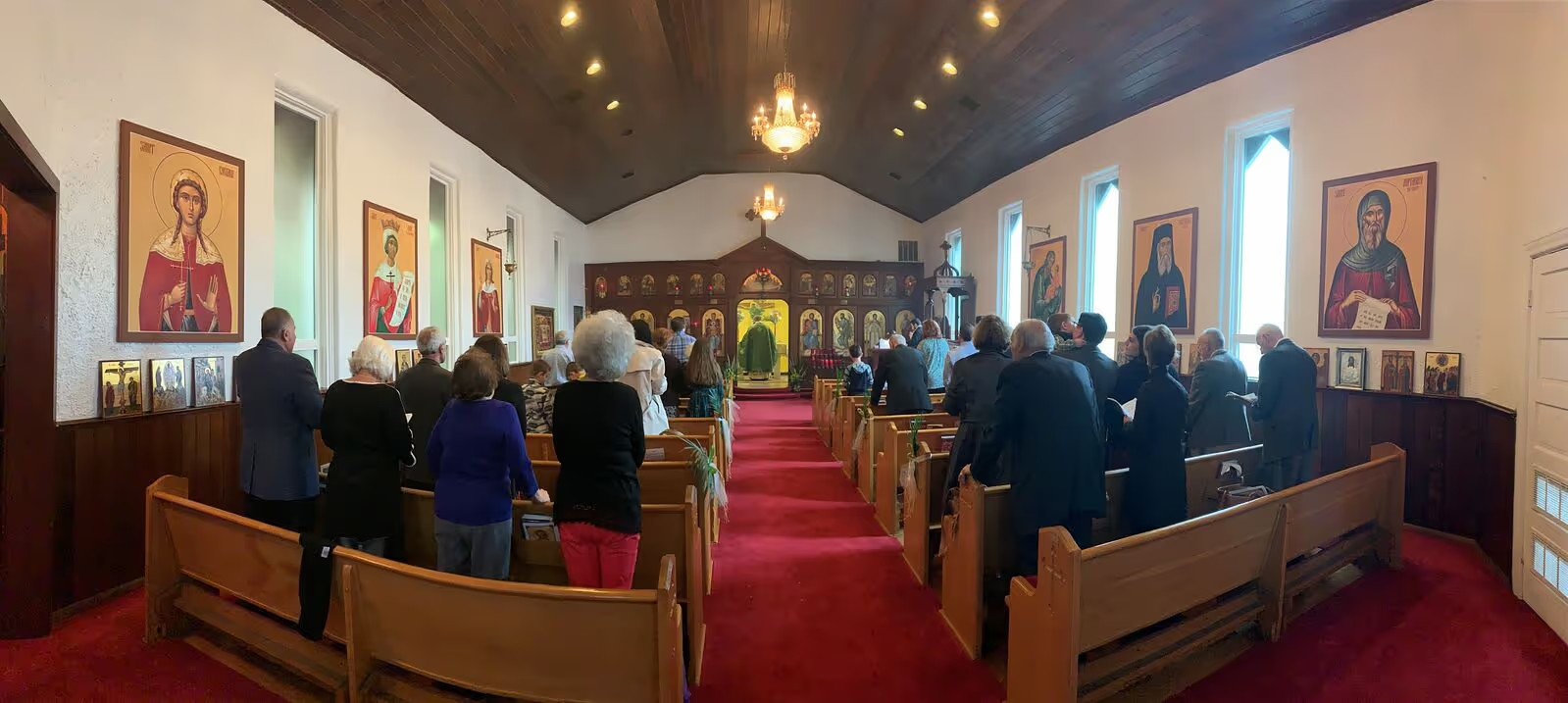
A woman raised in Protestant churches visited a Greek Orthodox parish in Savannah, Georgia. Stepping inside, she was overwhelmed by a sense of holiness, her legs “filled with lead,” and she heard a clear voice say “Welcome home.” She wept through the Divine Liturgy, recognised that the Eucharist is truly the Body and Blood of Christ and embraced Orthodox life with her husband.
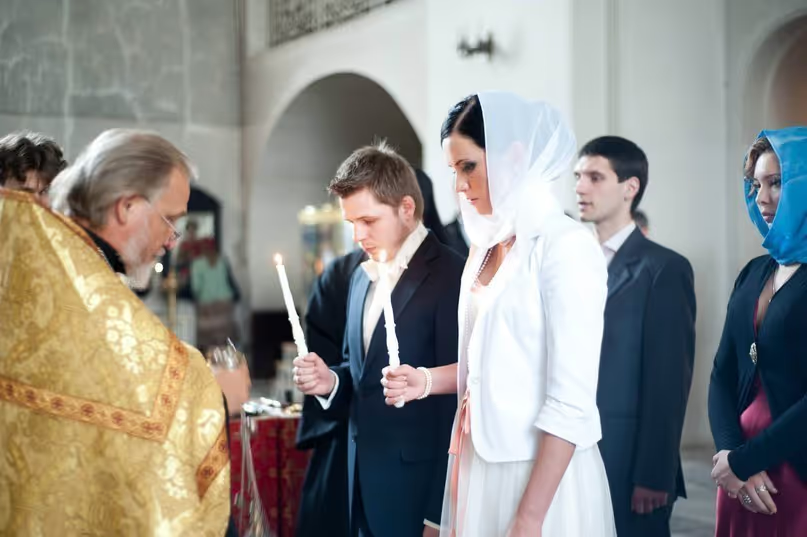
Former vocalist Igor Kapranov hit rock bottom amid substance abuse. In a moment of clarity he realised that he had to choose either Christ or death. He left his band, went to Valaam, embraced church life and prayer, and found healing and purpose.
.avif)
After dying in hospital, Vasily saw an indescribably loving, radiant figure he knew to be Christ. He communicated with the Lord without words, felt deep remorse for his past and was sent back to life to change his ways. His testimony emphasizes that God’s love continues beyond death.

A Basque man steeped in Buddhist practice visited the Holy Trinity–St Sergius Lavra near Moscow. As he venerated the relics of St Sergius, he felt an invisible force like fire pass through him, an experience that led him to seek baptism on Mount Athos and receive the name Epiphanius.

A Norwegian engineer who underwent multiple spinal surgeries cried out, “Lord, why is this happening?” in the depths of his suffering. Through prayer and a friend’s encouragement, he found faith, was baptized into the Orthodox Church and testified that his life was transformed.
Find answers to life’s deepest questions
Christianity is more than a religion - it’s a journey of faith, hope, and love. Discover its core beliefs, the life of Jesus Christ, and the teachings that have transformed millions of lives. This section also delves into the history of Christianity, its role in shaping civilizations, and its relevance in today’s modern world.
There is one true Church founded by Jesus Christ, built on Christ the cornerstone and the apostles (Eph 2:20) to carry His truth and grace. The Orthodox Church preserves this apostolic faith in her worship, sacraments, and life. “You are Peter, and on this rock I will build my church” (Matthew 16:18).
Science does not prove the existence of God directly, but it points to rational grounds for belief: the orderliness and fine-tuning of the universe, the origin of the laws of nature and human consciousness are difficult to explain without an intelligent First Cause.
God did not create suffering. It is a consequence of falling away from Him. The Lord does not forcibly remove suffering, as He respects human freedom and even uses pain as a path to healing, maturity, and encountering Him; at the same time, He Himself shared in human suffering through His death on the cross, rather than remaining aloof. “All things work together for good to those who love God” (Romans 8:28).
After death, a person does not disappear or dissolve into nothingness: the soul leaves the boundaries of this world and enters into God's reality, where perfect life is revealed; there are no wars, violence, diseases, fear, grief, or loss there, because all these things belong to the temporary, earthly world. Orthodox Christianity says that it is better there than here — not as an escape from earthly life, but as a transition to its fullness, where love, peace and life can no longer be taken away.
Orthodoxy is the true Church founded by Jesus Christ, preserving the original faith and teachings of the apostles. It follows ancient creeds and traditions, maintaining unity in doctrine, worship, and sacraments. The Orthodox Church guards God's truth faithfully throughout history as the pure body of Christ.
We need the Church because it brings God's grace through sacraments, teaches God's truth, and unites believers. It supports your faith journey and continues Christ’s work on earth. “Where two or three are gathered in my name, there am I among them” (Matthew 18:20).
Living as a Christian today means following Jesus' teachings with faith, love, and courage amid modern challenges. It calls for prayer, reading God's Word, participating in the Church, and showing compassion to others. Christians are called to be salt and light - standing firm in truth while loving their neighbors. This transforms not only individual lives but also society. “You are the light of the world” (Matthew 5:14).