
What is Orthodox Christianity? Discover Its Depth
What is Orthodox Christianity? Explore its ancient roots and living faith. Dive into this journey. Read now!

What is Orthodox Christianity: An Ancient Faith That Still Surprises Me
If you've ever wondered "What is Orthodox Christianity?" and walked into an Orthodox church for the first time, you probably noticed something you weren't expecting. The incense. The chanting. Icons gleaming in candlelight. My own first encounter caught me completely off guard — I'd grown up Catholic, thought I understood Christian worship pretty well. But stepping into that church changed something. It wasn't nostalgia. It wasn't just beautiful aesthetics.
This was different.
Here was faith that breathed with ancient rhythms, yet felt completely alive. Not Christianity preserved in amber. Living Christianity.
That encounter stayed with me for years. Honestly, it's part of what led me to ordination. I couldn't shake this realization — the Orthodox Church wasn't just keeping old traditions on life support. These people were actually living them. The worship, theology, prayer, fasting, Holy Mysteries. Nothing felt like museum pieces. It felt like coming home to something I'd been searching for without knowing it.
Here's what most explanations miss: the lived experience. How it actually feels to be Orthodox day by day. The warmth when the community lingers after Liturgy. How confession changes you — yes, the weight of it, but also the relief. The quiet joy I've discovered in morning prayers during Munich winters, even at 6am when it's still dark and bitter cold.
So let me try explaining what Orthodox Christianity really is. Not like an encyclopedia entry. Not from the outside looking in. But as someone who searched for it, found it, and has been shaped by it every day since.
✏️ By Father Victor Meshko | 📅 Updated: March 2026 | ⏱️ 9 min read
Quick Answer: Orthodox Christianity is the ancient, apostolic Church founded by Jesus Christ and His Apostles, preserving the original Christian faith through Holy Tradition, Scripture, the Seven Ecumenical Councils, and the teachings of the Church Fathers — centered on the Divine Liturgy and the goal of theosis: genuine union with the living God.
In This Article:
- What is Orthodox Christianity: An Ancient Faith That Still Surprises Me
- What is Orthodox Christianity: Core Beliefs and Doctrines
- What is Orthodox Christianity: History and Development
- What Does Orthodox Worship Actually Look Like?
- How Does Orthodox Christianity Compare to Catholic and Protestant Christianity?
- What Is Father Victor's Perspective on Orthodox Christianity in Modern Life?
- What People Often Get Wrong About Orthodox Christianity
TL;DR — Key Takeaways
- Orthodox Christianity is the original apostolic Church, preserving unchanged the faith handed down from Christ and the Apostles through an unbroken line of bishops and councils.
- Its central teaching is theosis — that human beings are genuinely called to participate in the divine nature of God (2 Peter 1:4), not just receive forgiveness but actually become more fully human and more fully alive in God.
- The practical heart of Orthodox life is the Divine Liturgy, the seven Holy Mysteries (sacraments), daily prayer, fasting, and confession.
- Orthodox Christianity isn't frozen in time — it's actually one of the most grounded and contextually responsive forms of Christian faith for people navigating the pressures of modern life.
What is Orthodox Christianity: Core Beliefs and Doctrines
Let's start with the basics. Then we'll dig deeper — because basics alone won't tell you what you really need to know.
Orthodox Christians believe in the Holy Trinity: one God in three Persons — Father, Son, and Holy Spirit. The Son, Jesus Christ, is fully God and fully man. The Holy Spirit proceeds from the Father alone, as Christ Himself said: "But when the Helper comes, whom I will send to you from the Father, the Spirit of truth, who proceeds from the Father, He will bear witness about me" (John 15:26). We summarize our faith in the Nicene-Constantinopolitan Creed, which the Church formulated at the First and Second Ecumenical Councils in 325 and 381 AD.
And it hasn't changed since.
But here's what I've noticed — when people ask what Orthodox Christians believe, they're expecting a checklist of doctrines. Fair enough. But Orthodox theology has always insisted that doctrine isn't just propositions to memorize. It's a way of life to live. As the Fathers teach, theology gets prayed before it gets written down. Acts 2:42 describes the earliest Christians as devoted to "the apostles' teaching and fellowship, to the breaking of bread and the prayers." That pattern — teaching, community, Eucharist, prayer — is still how Orthodox life works today.
Now here's the part that really matters: theosis.
Actually, let me put this differently. Theosis isn't just one teaching among others. It's the whole point. St. Peter writes that through Christ we become "partakers of the divine nature" (2 Peter 1:4). The Fathers understood that salvation isn't only about forgiveness — it's about transformation. Real union with God. St. Athanasius of Alexandria put it this way in the fourth century: God became man so that man might become god. Not gods like the pagans imagined. But genuinely, graciously, mysteriously alive with divine life.
Worth repeating.
I first encountered this teaching properly when I was studying at LMU Munich. It stopped me cold. I'd never heard Christian salvation described with such confidence and beauty. Honestly, it still surprises me. This understanding of theosis sets Orthodox Christianity apart from Catholic and Protestant approaches to salvation in profound ways.
What is Orthodox Christianity: History and Development
Orthodox Christians don't see the Church as something that started in medieval times, or during the Reformation, or at any later date. We trace our origin directly to Christ's Great Commission — "Go therefore and make disciples of all nations, baptizing them in the name of the Father and of the Son and of the Holy Spirit" (Matthew 28:19) — and to the descent of the Holy Spirit at Pentecost.

The apostles passed on their authority through the laying on of hands, as described in Acts 8:17 and 1 Timothy 4:14. Every Orthodox bishop today stands in an unbroken line of that apostolic succession. We don't claim this lightly. The Church has guarded this succession with extraordinary care across nearly twenty centuries. Read more: What Do Orthodox Christians Believe? The Main Truths of Our....
Between 325 and 787 AD, the Church gathered in Seven Ecumenical Councils to define the faith against various distortions. Nicaea in 325. Constantinople in 381. Ephesus in 431. Chalcedon in 451. And three more after that. These councils didn't invent new doctrines — they clarified, with precision, what the Church had always believed and prayed. The Orthodox Church accepts all seven of these councils as authoritative.
No more, no less.
The Great Schism of 1054 separated the Eastern and Western churches — Rome going one direction, the Orthodox East another. I knew the Catholic tradition well, having grown up in it. I say this with genuine respect: the differences are real and theologically serious, but they don't erase our shared Christian heritage. What I found in Orthodoxy wasn't a rejection of everything I'd known. It was completion. Or maybe more honestly, coming home to something older than the divisions themselves.
Today the Orthodox Church numbers about 250 million believers worldwide, united in a communion of self-governing (autocephalous) churches — Constantinople, Alexandria, Antioch, Jerusalem, Russia, Greece, Serbia, Romania, and others. The Ecumenical Patriarch of Constantinople holds a place of honor as "first among equals," but there's no single head with authority over the whole Church. Our unity is conciliar — rooted in shared faith, not centralized governance. For those seeking to understand Eastern Orthodox Christianity in its global context, this conciliar structure represents one of the most distinctive features of Orthodox ecclesiology.
What Does Orthodox Worship Actually Look Like?
Someone came to our parish in Munich not long ago — a young man in his late twenties, curious but overwhelmed. After the Liturgy, he found me and said, "Father, why does it feel so... different? I've been to Catholic Mass, I've been to Protestant services. This is something else entirely."
I smiled. Not quite what I expected him to say, but I've heard versions of it dozens of times.


Orthodox worship engages your whole person. Your eyes take in icons — windows, as we say, to the heavenly world, not idols. Your nose catches incense, which the Psalms describe as a symbol of prayer rising to God. Your ears follow ancient chants unchanged since the Byzantine period. Your body bows, prostrates, makes the sign of the cross. Your tongue receives Holy Communion — the Body and Blood of Christ, truly present in the Eucharist.
The Divine Liturgy is the heart of Orthodox worship. We use primarily the Liturgy of St. John Chrysostom, a fourth-century archbishop of Constantinople, though the Liturgy of St. Basil the Great is also celebrated on certain occasions. During the Liturgy, we experience what the Church has always understood as participation in the heavenly worship — the boundary between time and eternity becoming, for a moment, thin.
Every single time.
Orthodox life also includes daily prayer — most Orthodox Christians follow a morning and evening prayer rule from the prayer book. We fast on Wednesdays and Fridays and during four major fasting periods throughout the year. Orthodox fasting might seem extreme to outsiders, but it's actually about freedom — freeing the will from appetite so the heart can attend to God. Confession and Holy Communion are the two Holy Mysteries I encourage my parishioners to return to most regularly. And pilgrimage has always been part of Orthodox life. I've watched people return from pilgrimages to Jerusalem or Athos genuinely changed.
Hard to explain, but real.
How Does Orthodox Christianity Compare to Catholic and Protestant Christianity?
This comes up often. I want to answer honestly, without caricature — because the differences matter, and so does mutual respect.
Here's a comparison of the main theological differences. But let me add a few pastoral notes afterward.
[COMPARISON_TABLE]
The Filioque question — whether the Holy Spirit proceeds from the Father alone, or from Father and Son — might sound like theological hairsplitting. But it isn't. It touches directly on how we understand God's inner life and how divine grace actually reaches us. The Orthodox Church holds to the original Creed as defined at Constantinople in 381 AD, unchanged. That's not stubbornness. It's faithfulness to what the Church agreed together, before the divisions happened. See also: What Is Christianity? A Clear, Hopeful Guide to the Good....
But maybe that sounds too harsh. Let me step back. I don't want to turn comparison into competition. What I genuinely believe is that Orthodox Christianity offers something distinctive — not superior in some triumphalistic sense, but distinctive in the sense of completeness. The emphasis on theosis, on the uncreated energies of God (theology developed in the fourteenth century by St. Gregory Palamas), on the whole person being drawn into union with God — this is something I haven't found articulated with the same depth elsewhere. Understanding what Orthodox Christianity vs Protestant Christianity means becomes clearer when examining these theological distinctions, particularly around the role of tradition and the understanding of salvation.
What Is Father Victor's Perspective on Orthodox Christianity in Modern Life?
Everyone assumes Orthodoxy is frozen. A beautiful relic.
I'm honestly not sure that's fair — and I've thought about it a lot.
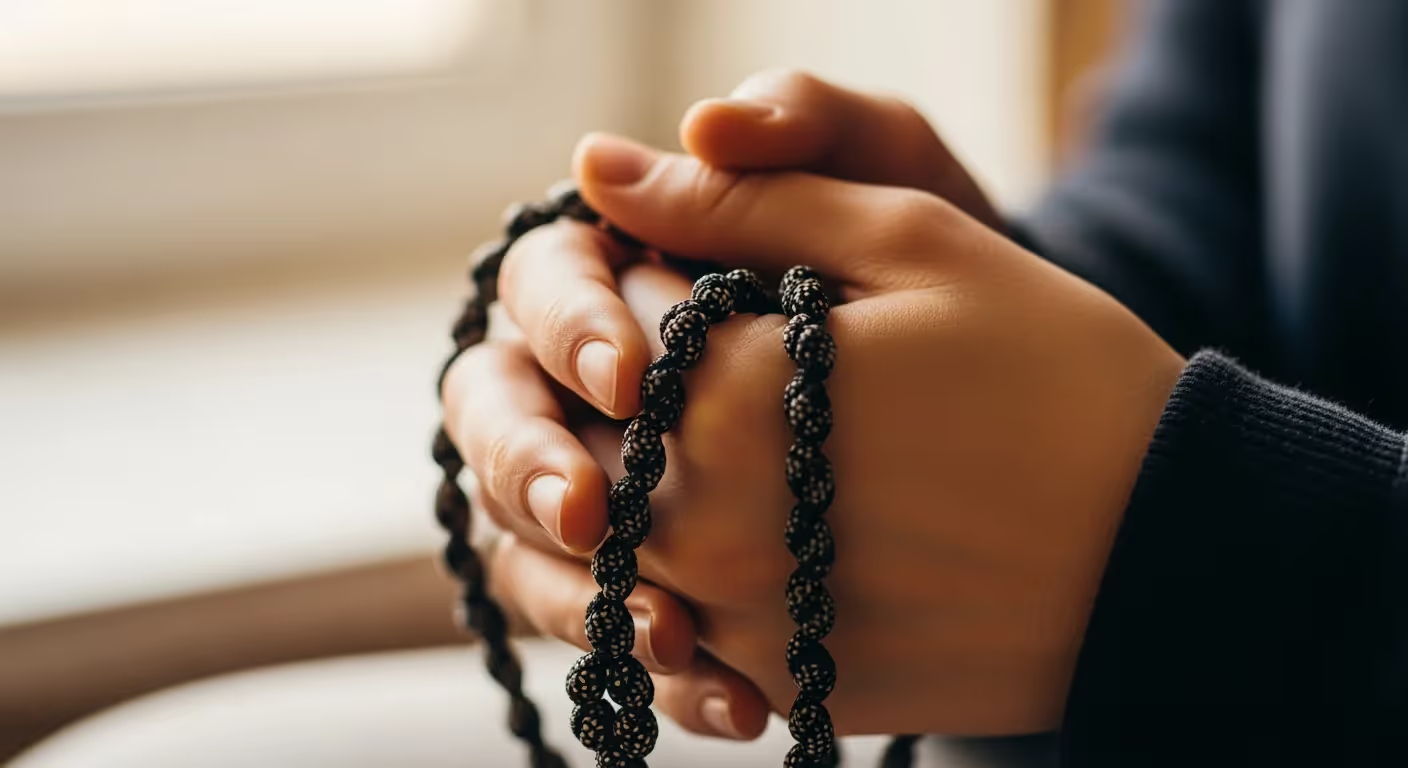
People often think Orthodox Christianity simply preserves ancient forms against pressure from modernity. Yes, the Church guards the Faith carefully. But in my years of pastoral ministry, I've seen something different: Orthodox Christianity's very insistence on lived theology — on prayer, fasting, confession, communion, the rhythm of the liturgical year — makes it surprisingly well-suited for people exhausted by the pace of contemporary life. Not by escaping modernity. But by offering a different kind of attention.
Last year, a woman came to me — she couldn't have been older than thirty — completely burned out. She said her mind never stopped. She was on her phone from the moment she woke up. She'd tried meditation apps, therapy, journaling. "Father," she said, "I don't know how to be still."
I've heard that question more times than I can count.
What I told her was simple: start with the Jesus Prayer. Just a few minutes, morning and evening. "Lord Jesus Christ, Son of God, have mercy on me, a sinner." The Jesus Prayer — and I say this after years of personal practice — still surprises me with what it does to the mind and heart. It's not a technique. It's a meeting.
Here's the thing: Orthodox Christianity doesn't offer spiritual productivity hacks. It offers something slower and more demanding and, in my experience, more real. The hesychast tradition — the tradition of inner stillness cultivated by the Desert Fathers and articulated by St. Gregory Palamas — understood centuries ago that the human heart needs quiet to find God. And quietly, that tradition is drawing people in today. Not in spite of its demands. Because of them.
I've gone back and forth on how to explain this. Here's where I've landed: Orthodoxy doesn't adapt to the age by changing its theology. It serves the age by holding firm to a vision of what human beings are actually for. And that vision — theosis, union with God, becoming more fully human by being drawn into divine life — turns out to be exactly what people are hungry for, whether they know it yet or not. What is Orthodox Christianity in simple terms? It's the ancient path to becoming fully human through divine grace.
What People Often Get Wrong About Orthodox Christianity
Misconception 1: "Orthodox Christianity is just a branch or denomination."
It isn't. The Orthodox Church understands herself as the continuous apostolic Church — not a later development or a regional variation of some earlier original. The Seven Ecumenical Councils defined the Faith; the Orthodox Church has lived within that definition ever since. So while it's common to list Orthodox, Catholic, and Protestant as three "branches," that framing is at least partly misleading. Orthodoxy's claim is older and more specific than that.
Misconception 2: "Orthodox Christians worship icons or venerate Mary like a goddess."
Not even close. The Church distinguishes carefully between latreia (worship, given to God alone) and proskynesis (veneration, offered to the saints and to the Theotokos — the God-bearer, the Virgin Mary). The Seventh Ecumenical Council in 787 AD defined this distinction precisely. Icons aren't idols. They're windows — visible reminders of the invisible reality of those who are alive in God. And the Theotokos is honored as the greatest of all the saints, the one who carried God in her womb, but she's never worshipped.
Misconception 3: "Orthodox Christianity doesn't accept the Trinity or Christ's full divinity."
The opposite is true. Orthodox theology formulated the doctrine of the Trinity — at Nicaea in 325, at Constantinople in 381 — with extraordinary precision. The Nicene Creed, which most Christians recite in some form, came from these Orthodox councils. Christ is fully God and fully man, two natures united without confusion or separation. This is the faith the Church defined against Arius, against Eutyches, against Nestorius. Read more: Orthodoxy and Catholicism: Understanding the Divine....
Misconception 4: "The Orthodox Church has a Pope."
It doesn't. The Ecumenical Patriarch of Constantinople holds a place of honor — "first among equals" — but doesn't hold authority over the other autocephalous churches. Our governance is conciliar, not papal. Bishops gather in councils. Decisions are made together. That's not a weakness; it's a feature.
Misconception 5: "Orthodox Christians ignore the Bible."
The entire Divine Liturgy is woven from Scripture. The Psalms, the Epistles, the Gospels — they're not supplementary to Orthodox worship; they're the warp and weft of it. But Orthodoxy reads Scripture within Holy Tradition — the living context of the Church's prayer, councils, and patristic commentary. Scripture doesn't interpret itself in a vacuum. The Church has always understood and taught it together.
Frequently Asked Questions
How does Orthodox Christianity differ from Christianity?
Orthodox Christianity is Christianity — specifically, the original apostolic form of it. The distinction people usually intend is from Catholic or Protestant Christianity. Orthodox Christianity differs from both by rejecting papal supremacy (unlike Catholicism) and by holding Holy Tradition alongside Scripture as equally authoritative (unlike most Protestant traditions). It's the faith of the Seven Ecumenical Councils, unchanged since the early centuries — not a later reform or development.
Do Orthodox Christians believe God is Jesus?
Orthodox Christians believe in the Holy Trinity — one God in three Persons: Father, Son, and Holy Spirit. Jesus Christ is the second Person of the Trinity, fully God and fully man. So yes, Christ is divine — completely and without qualification. But Orthodox theology is careful: the Father is God, the Son is God, the Holy Spirit is God, and yet there's one God, not three. That's the mystery the Nicene Creed articulates, and Orthodox worship has always prayed it, not just stated it.
What is the difference between Catholic and Orthodox?
The most significant differences are the Filioque (Orthodox hold that the Holy Spirit proceeds from the Father alone; Catholics added "and the Son" to the Creed), papal authority (Orthodox reject papal supremacy and infallibility), and certain later Catholic doctrines (like the Immaculate Conception, defined in 1854, or purgatory in its Western form) that the Orthodox Church doesn't accept. Both traditions have seven sacraments, apostolic succession, and deep reverence for the Theotokos. The differences are real — but so is the shared ancient heritage.
What rules do Orthodox Christians follow?
Orthodox life is guided by the canons of the Ecumenical Councils and the apostolic tradition, but I'd hesitate to call it a "rule book." The practical shape of Orthodox Christian life includes daily prayer (morning and evening), fasting on Wednesdays and Fridays and during four major fasting seasons, regular participation in the Divine Liturgy, frequent confession and Holy Communion, and living according to the Church's moral teaching. Plus the liturgical calendar, which gives the whole year a rhythm — feasts, fasts, commemorations of saints. It's not legalism. It's a way of training the whole person — body, mind, and soul — toward God.
I don't say this lightly: the disciplines of Orthodox life, taken seriously, genuinely change people. I've watched it happen. And I've experienced it myself.
What I want to share with you is this. I don't want to hide or bury the treasure, the joy, and the happiness that were granted to me. I want to share this experience with you, leaving each person the freedom of personal choice. My message is simple and sincere: trust in God, open your hearts to Him, participate in the Holy Mysteries of the Orthodox Church — and He will surely comfort you and lead you to a life that is deeper, more whole, and more joyful. That's not a promise I make. It's an invitation He makes. And it's been true in my life, in ways I'm still discovering. This is what Orthodox Christianity offers to all who seek: not merely knowledge about God, but genuine participation in divine life through the ancient apostolic faith preserved unchanged through the centuries. For anyone seeking comprehensive understanding of Eastern Orthodox tradition, the path begins not with academic study alone, but with stepping into the lived experience of this ancient faith.
About the Author
Father Victor Meshko is an Orthodox priest serving at the Cathedral of the Holy New Martyrs in Munich, under the Russian Orthodox Church Abroad. Ordained in 2013 by Metropolitan Mark (Arndt), he holds a Doctorate in Theology from Ludwig Maximilian University of Munich (LMU) and a Master's degree in Psychology. His published theological works include research on Archbishop Filaret (Gumilevskij) of Chernigov and a study on the prophetic-eschatological character of the Book of Revelation. In his ministry, he places special emphasis on spiritual psychology — bringing together Christian ethics and theology with modern psychological science. Raised Catholic, he came to Orthodoxy through a process of personal search and conviction, and now shares the faith with warmth and scholarly depth at findtogod.com.
Researched and written by Father Victor Meshko. AI tools were used during the research process.
<table><thead><tr><th>Topic</th><th>Orthodox</th><th>Catholic</th><th>Protestant</th></tr></thead><tbody><tr><td><strong>Church Authority</strong></td><td>Conciliar — Seven Ecumenical Councils; bishops in apostolic succession; no single earthly head.</td><td>Papal supremacy and infallibility (defined at Vatican I, 1870).</td><td>Sola scriptura — Scripture alone; congregational or denominational authority.</td></tr><tr><td><strong>Holy Spirit Procession</strong></td><td>From the Father alone (John 15:26; original Nicene Creed).</td><td>From the Father <em>and</em> Son (Filioque, added to the Creed in the West around 1014).</td><td>Varies; generally Trinitarian but scripture-focused.</td></tr><tr><td><strong>Tradition and Scripture</strong></td><td>Holy Tradition — Scripture, Church Fathers, and Councils — as one unified source of the Faith.</td><td>Scripture, Tradition, and the Magisterium (papal teaching authority).</td><td>Scripture alone as the rule of faith.</td></tr><tr><td><strong>Salvation and Theosis</strong></td><td>Lifelong deification through grace, the Holy Mysteries, and synergy with God (2 Peter 1:4).</td><td>Justification and sanctification through faith and works.</td><td>Faith alone (sola fide) in most traditions.</td></tr></tbody></table>

Father Victor Meshko
Help us bring ancient faith to modern seekers worldwide.
FindtoGod relies on generous souls to sustain our multilingual platform, develop new tools like the Magic Cube, and support struggling believers. If our work has touched your heart, consider contributing to our nonprofit partner

Do you want to know More? Ask God’s Word!
Do you have questions, worries, or hopes? Feeling lost, burdened, or alone? “Ask God’s Word” brings you gentle guidance rooted in Scripture and the wisdom of the Church. Find hope and strength today!
